The Belfast Mandate belongs in the direct spiritual lineage of the Reformation—but it also declares that the Reformation was left unfinished.
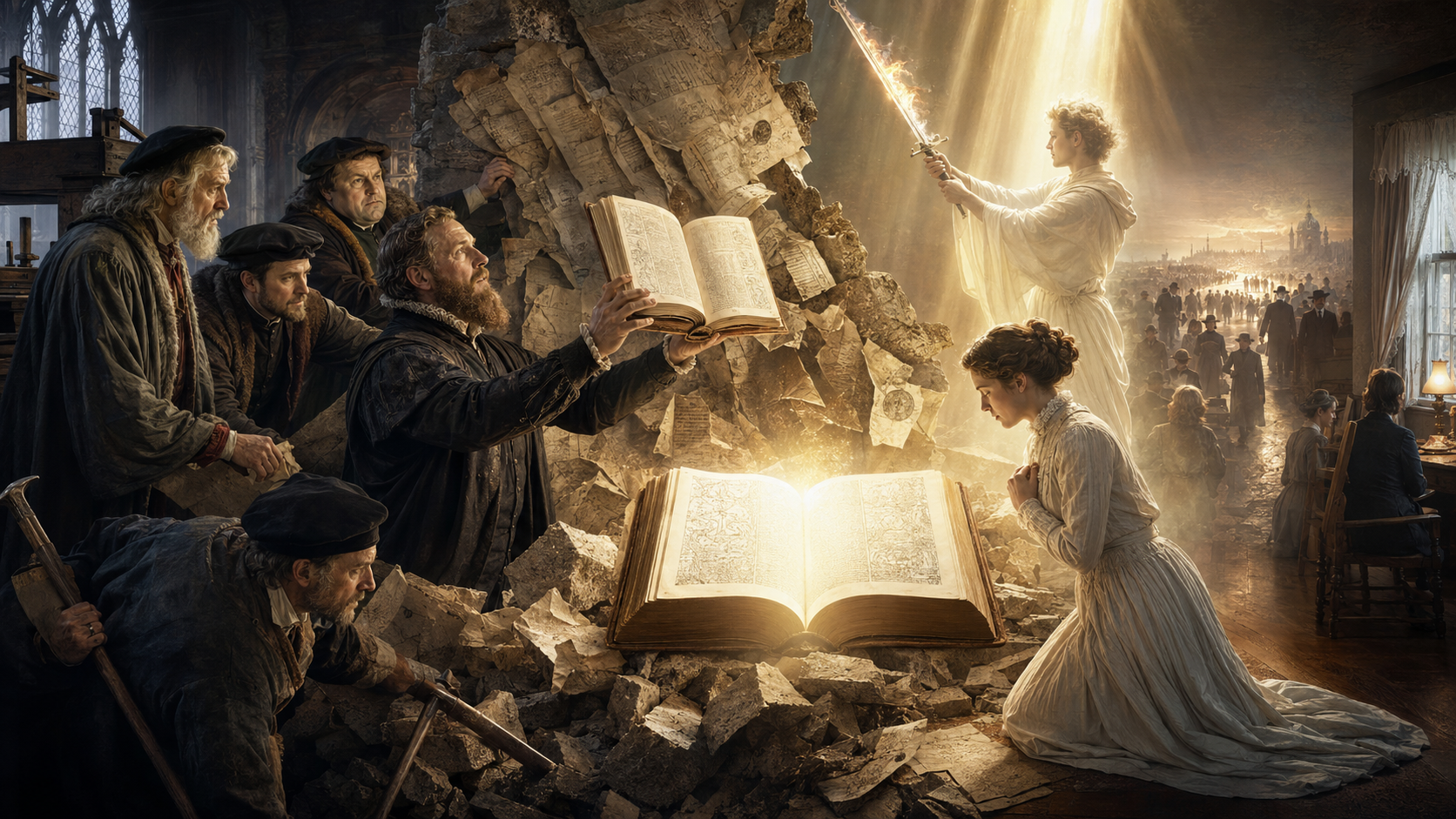
The Reformers broke open the wall surrounding the Book. The Belfast Mandate reveals that religious men subsequently built another wall around it.
| Reformer | What obscured the Book | What the Reformer did | Alignment with Belfast |
|---|---|---|---|
| John Wycliffe | Scripture was withheld from ordinary people behind Latin, clerical privilege, and ecclesiastical authority. | Defended the supreme authority of Scripture and helped bring the Bible into English. | He began removing the wall so the nations could see the Book’s light. |
| Jan Hus | Corrupt clergy claimed authority while contradicting Christ in their lives and teachings. | Proclaimed that Christ—not a corrupt religious hierarchy—is the true Head of the Church. | He challenged the men in “priestly robes” who stood between the people and the Word. |
| Martin Luther | Indulgences, inherited traditions, and priestly mediation obscured justification through Christ. | Recovered justification by faith and translated Scripture for the German people. | He tore away doctrines of men that concealed the sufficiency of Christ. |
| William Tyndale | The English clergy controlled access to Scripture and persecuted those who translated it. | Gave the English people the words of God in language they could understand. | He made the Book shine beyond the walls built around it. |
| John Rogers | English believers still lacked a complete, accessible, organized Bible for study. | Compiled and published the Thomas Matthew Bible, adding marginal notes, cross-references, chapter summaries, and learning aids. | He did not merely uncover the Book; he equipped ordinary people to read, compare, understand, and obey it. |
| Huldrych Zwingli | Church practices rested upon tradition without clear scriptural authority. | Tested worship and doctrine by Scripture and rejected practices he could not find there. | He challenged the “writings” laid over the Book—but sometimes replaced them with conclusions of his own. |
| Menno Simons and the Anabaptists | State churches confused compulsory religious membership with conversion and discipleship. | Restored emphasis on repentance, voluntary faith, believer’s baptism, holiness, and the practical teachings of Jesus. | They carried the Reformation from correct doctrine toward an obedient, transformed life. |
| John Calvin | Medieval theology had buried grace and biblical exposition beneath elaborate systems. | Produced disciplined, verse-by-verse biblical teaching and emphasized God’s sovereignty. | He helped recover the text, but his own theological system could itself become another interpretive wall. |
| George Fox and the early Friends | Protestantism could possess the Bible while remaining spiritually formal, clerical, and lifeless. | Reasserted the present leading of the Holy Spirit and the spiritual equality of men and women. | They insisted that the Book must be illuminated by the Spirit, not merely defended as ink and paper. |
| John Wesley | Protestant orthodoxy had often become cold, respectable, and spiritually powerless. | Restored the call to repentance, the new birth, holiness, disciplined discipleship, and open-air evangelism. | He helped the rivers of living water flow beyond church walls to neglected people. |
| William and Catherine Booth | Churches often ignored the poor, women evangelists, and those outside respectable society. | Carried the Gospel into streets, slums, and public halls while releasing women to preach. | Their ministry anticipated the Belfast command to carry the illuminated Word wherever God sends. |
| Aimee Semple McPherson | The Bible had again been covered “page by page” by the theories, creeds, traditions, and unbelieving conclusions of religious men. | Was commanded to look away from human theories, receive the Word as illuminated by the Holy Spirit, clear away the debris, and hold the Word of power before the nations. | The Belfast Mandate is a prophetic summons to continue—and correct—the unfinished Reformation. |
Central Alignment
The imagery matches remarkably well.
| Belfast Mandate image | Reformation fulfillment |
|---|---|
| The radiant Book | The living Word of God, possessing authority above councils, traditions, and clergy |
| Pages covered over | Scripture obscured by untranslated language, traditions, creeds, scholastic theories, and institutional claims |
| “Wisdom of Man” | Human theology assuming authority over the plain testimony of Christ |
| Men in priestly robes | Religious officeholders who controlled, interpreted, or withheld the Word from ordinary believers |
| Stones, bricks, and mortar | Layer upon layer of doctrine and institutional authority built up around the Bible |
| The messenger’s flaming sword | The Word of God, wielded in the power and illumination of the Holy Spirit |
| The wall falling | Scripture restored to the people and false religious authority exposed |
| Rivers flowing outward | The recovered Gospel reaching nations, captives, the poor, women, and those excluded by religious systems |
| “Hold thou My Word” | The continuing responsibility to proclaim Scripture without covering it again |
Rev. John Rogers Occupies a Special Place
John Rogers may be the clearest Reformation counterpart to the Belfast messenger.
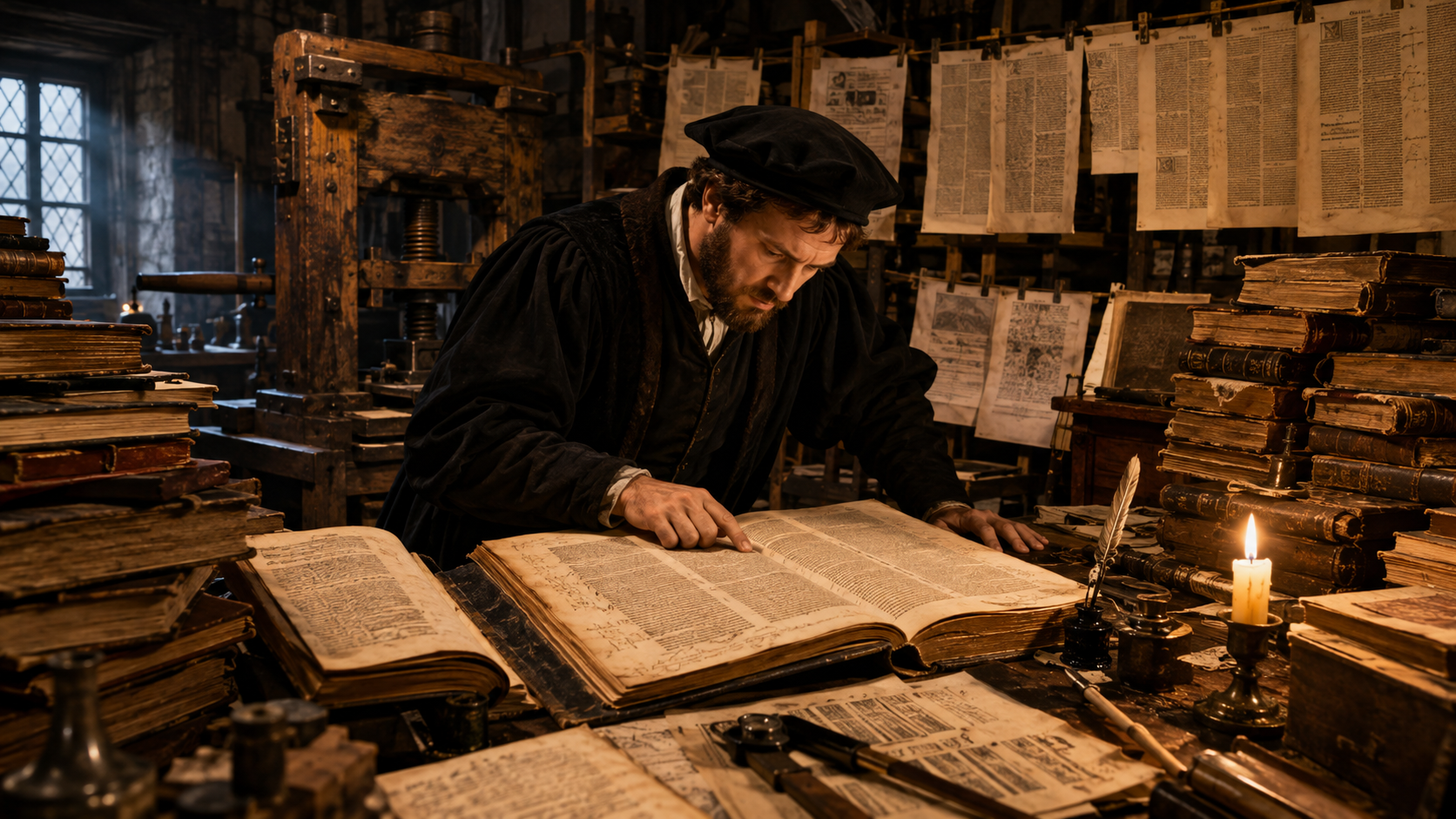
Tyndale translated much of the English Bible. Rogers gathered that work, completed it with the remaining Old Testament material associated with Miles Coverdale, organized it, supplied extensive study helps, and placed the finished Bible before the English people. He did precisely what the Belfast vision symbolically depicts:
- He brought the Book out from clerical custody.
- He caused its light to shine in the common language.
- He equipped ordinary readers to compare Scripture with Scripture.
- He exposed doctrines and practices that contradicted the Word.
- He refused to withdraw his testimony when religious authorities demanded it.
- He sealed that testimony as the first Protestant martyr under Queen Mary.
Rogers did not merely say that people should have the Bible. He built a practical Scripture Learning System so they could understand it without absolute dependence upon the clergy. That places the Thomas Matthew Bible very near the heart of the Belfast Mandate.
John Rogers
Show Lyrics
The candle has burned to the socket,
And midnight has passed into morn;
The ink stains the hand of the servant,
The edges of every page worn.
No congregation before him,
No multitude calling his name—
Just one man bent over the Scriptures,
And England asleep in the rain.
While England slept, he kept the light,
Page by page through the longest night;
No crown, no praise, no voice was heard—
Just one man laboring for the Word.
The books rose like walls all around him,
Old witnesses opened and weighed;
A passage compared with a passage,
A pathway through darkness was laid.
The chapters were gathered and ordered,
The margins with lanterns were lined;
That plowboy might search through the Scriptures,
And no priest hold the key to his mind.
While England slept, he kept the light,
Page by page through the longest night;
Through ink and ache, through whispered prayer,
He made the hidden treasure clear.
From Tyndale, the words bought with exile;
From Coverdale, pieces still known;
He gathered the work of the faithful
And bound it as one cornerstone.
Then “Thomas Matthew” stood on the title—
A name made to shelter the flame;
But beneath it, the hand of John Rogers
Had quietly ordered the same.
The sheets left the press in the morning,
Still breathing the fragrance of ink;
They traveled to cottages, workshops—
To people once forbidden to drink.
A mother read mercy by firelight,
A laborer sounded each word;
And England began to awaken
To the voice of her crucified Lord.
While England woke, he raised the light,
Page by page against the night;
He gave the common man the Word—
And all across the land, it stirred.
Then darkness returned with a crown on,
And old walls were raised from the stone;
The man who had opened the Bible
Now answered for truth all alone.
They offered him life for recanting,
A silence in place of the flame;
But the hand that had steadied the pages
Would not take the truth from His name.
What good were the words he had printed
Recanting, a silence, in place of the flame
But the hand that had steadied the pages
Would not take the truth from His name.
What good were the words he had printed
If fear made him deny them now?
His wife and his children stood waiting
Along the last road he would tread;
He walked as a father among them,
With words of eternal life said.
No army came down to deliver,
No earthly reprieve had been won;
The servant who worked through the midnight
Now walked through the fire with the Son.
While England watched, he kept the light,
Faithful still in morning’s sight;
He gave the common man the Word,
Then sealed with fire what he had heard.
The fire consumed the faithful man,
But could not burn the Word he gave;
The pages passed from hand to hand—
The light outlived the flame.
While England slept, he kept the light,
Page by page through the longest night;
No crown of earth, no great reward—
Just one man faithful to the Word.
The candle has burned to the socket,
The first breath of dawn touches gray;
One man is bent over the Scriptures—
And night fer begun giving way.
And light outlived the flame.
The light outlived the flame.
Belfast Mandate Also Judged the Reformers
We shouldn't force the Mandate into the narrower claim that “the Protestants were right and Rome was wrong.” Its indictment is broader. The Reformers removed many Roman coverings from the Book, but Protestant leaders soon produced confessions, theological systems, state churches, denominational boundaries, and authorized interpretations of their own.
Some persecuted other reformers. Some defended compulsory religion. Some limited women whom the Holy Spirit had called. Some recovered justification while neglecting repentance, holiness, spiritual gifts, or the direct teachings of Jesus.
The true historical pattern is:
- God’s Word shines.
- Men surround it with doctrines and authority.
- God raises servants to break through the wall.
- Their followers systematize the recovery.
- The system gradually becomes another wall.
- God calls for the Book to be uncovered again.
The Belfast Mandate therefore does not merely commemorate the sixteenth-century Reformation. It summons a reformation of the Reformation.
Summary
- Wycliffe declared that the people must possess the Word.
- Tyndale gave the Word an English voice.
- Rogers assembled the Book, created a Bible Learning System in it, and placed it in the people’s hands.
- Luther broke the authority of the medieval wall.
- The Anabaptists called believers to obey what the Book actually said.
- Wesley carried its call to repentance and holiness into the open air.
- And in Belfast, the Lord showed Aimee Semple that the work was still unfinished: the Book had once again been covered by the wisdom of men. She was not commissioned to build another wall around it, but to clear away the debris and hold the living Word aloft until its light reached the nations.
The Reformers began clearing the Book; the Belfast Mandate commands that the clearing continue until Christ’s Word stands wholly in the light.